Today’s Tuesday Reading is from Marcia Dority, Program Leader and Leadership Coach at MOR Associates. Marcia may be reached at [email protected] or via LinkedIn.
“A leadership-type behavior is focused on the future; it is concerned with a vision that will help change the present to create a better future. A management-type behavior is focused on the present, concerned with stability in the here and now. Making the choice of which behavior to practice at any given point becomes a central challenge.” Linda E. Ginzel
Your Leading, Managing, Doing Ratio
How’s your LMD? Better yet, when’s the last time you checked your Leading, Managing, Doing ratios? A core concept of the MOR Leaders program is understanding how one spends their time on Leading, Managing and Doing activities. The greatest challenge, as Linda E. Ginzel points out in the above quote, is making the decision on which behavior to practice. Leadership is about doing the right things. Management is about doing things right.
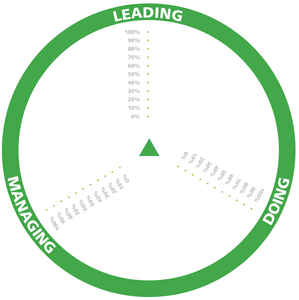
The first step is to determine where one spends their time and energy; it’s easy to be busy and check the to-do boxes. The LMD worksheet is an opportunity to assess our current balance. To better understand what that current state looks like, let’s define what those three activities include:
- Leadership activities are those activities that establish the direction of the organization and enable it to adapt to the challenges it faces. Examples: setting a direction, determining the strategy, sponsoring major initiatives, defining and engaging in activities that foster a culture befitting organizational strategy.
- Managing activities are those activities that guide the formation and organization of unit activities. Examples: building a project plan, establishing a work schedule, identifying process improvement opportunities, ensuring the results are getting delivered and delegating tasks to team members.
- Doing activities are the project, operational and administrative tasks that comprise the ultimate work of a unit. Example: resolving a customer problem, developing a website design, scheduling meetings and answering email.
Take a moment to complete the first section of the MOR Leading Managing Doing Worksheet. As of today, what is the current amount of time you spend on each activity? Take a moment to really look at your LMD portions. Now, complete section two of the worksheet – what would be your desired percentage of time spent on LMD?
Reflecting on One’s LMD
We can all improve with coaching, including coaching oneself. I offer a few coaching questions as we reflect on the LMD assessment:
- What did you think about your L-M-D distribution?
- What do you think underlies the way you see your time spent?
- How would you like to change it if you do?
- What could you do differently to shift this ratio?
To shift one’s LMD requires intentionality. To get started, we suggest determining your top three priorities. A MOR keystone practice is Monday/Friday defensive calendaring. On Monday morning take 30 minutes to determine the top three priorities that you need to complete in the next week or two. Then use your calendar to block the time YOU need to get it done. Are the priorities dependent on other people and/or teams? What can you delegate to others so that you can focus on the priorities? On Friday, take another 30 minutes to reflect on your top three priorities: did you complete them? If so, what contributed to that success? If not, what do you need to do differently the upcoming week to focus?
The third section of the LMD worksheet is for you to check your progress in 3-6 months. Future self will appreciate the work you do today! Add an LMD check-up to your calendar to see your progress in shifting your focus.
Conclusion
We need leaders to focus on strategic initiatives or goals. Leaders who ensure there is progress on the most important priorities. Leaders who are looking ahead to ensure our teams do the right things to position our organization to be successful in today’s ever changing, interdependent world. LMD is a simple yet powerful construct for increasing your leadership effectiveness by shifting your intention and use of time. The ultimate role of a leader is to deliver results, we can consistently do this by reflecting on what we learned about the results we delivered; so that we can do it even better next time.

What is one thing you will do to shift your LMD?
Last week, we asked which way you most wanted to increase your engagement as a leader in the coming week.
- 64% said acts of empathy
- 11% said active listening
- 9% said planning for the future
- 8% said facilitating success in others
- 4% said brave acts for just causes
- 4% said stepping up and serving

Regardless of which you picked, how’d ya do in increasing your engagement as a leader? Almost 2 out of every 3 of us wanted to work on being more empathetic. Here are some great ideas from the Tuesday Reading archives on listening with more empathy.
Resource
Leading, Managing, Doing – What’s the Difference? by Brian McDonald