Today’s Tuesday Reading is from Marcia Dority, Program Leader and Leadership Coach at MOR Associates. Marcia may be reached at [email protected] or via LinkedIn.
“You lead people, you manage things” – Rear Admiral Grace Murray Hopper
Are you leading strategic change or tactically managing change? Option one is future-focused, scanning the horizon for what and where we position our organizations for future success. The second option assumes we can contain change and control the outcome and impact on our organization.
Defining the MOR 5P’s of Leading Strategic Change
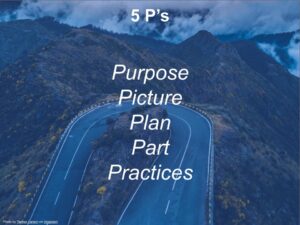
As change is constant, the 5P’s is a tool that can be used with any type of change so that we continue to move forward. To lead change, we need to clearly define what it is. The first P or Purpose is the foundation or the age-old question, Why?
The second step focuses on the Desired Future State. As humans are visual learners, the second P is the Picture or an image of the desired future state. The phrase, “a picture is worth a thousand words” pays long-term dividends at this step in leading change.
Once we have defined why the change is taking place and what it looks like, the next step or third P is the Plan. This is a key phase in change, the road map to success or how we will move to the desired future state. A travel analogy; are we taking a road trip to the national parks, or are we spending a relaxing week on the beach? The plan to get us to each of those desired future states is very different. Once we have the Picture of where we’re heading, the Plan is how we get there.
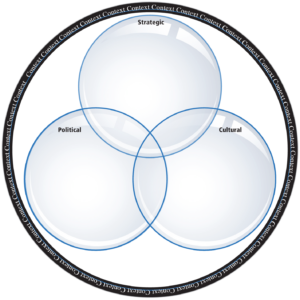
Recall the Three Lenses: the Strategic, Political and Cultural from the MOR Leaders programs. The Cultural and Political lenses can be especially challenging as these are the people-focused lenses. The fourth P or Part is critical to leading strategic change. As humans, we want to know what’s in it for us including change. Not explaining to our people the Part they will play in the desired future state is a deal breaker. Leaders understand that showing their people the part they have in change will bring them onboard.
The final P does not complete the 5P’s, instead it sets up the foundation for success. These are the Practices necessary to facilitate new behaviors. We cannot keep doing what we’ve always done as we lead change. So what are the new habits or behaviors we need to create and consistently practice to move forward?
“A leadership-type behavior is focused on the future; it is concerned with a vision that will help change the present to create a better future. A management-type behavior is focused on the present, concerned with stability in the here and now. Making the choice of which behavior to practice at any given point becomes a central challenge.” Linda Ginzel
MOR’s Leading Change Solution
MOR is finalizing a new solution that builds on our extensive experience supporting leaders in leading strategic change. MOR Change Leaders is an immersive experience in which each participant brings a live change effort to develop throughout the program.
The experience begins with a two-and-a-half-day workshop focused on change leadership best practices, frameworks, and processes. Serving as a learning lab, the workshop enables participants to begin applying new tools and approaches to advance their real-world change efforts.
Following the workshop, participants engage in 60 days of applied learning with support from MOR coaches and experienced change leaders. The experience concludes with a one-day workshop focused on reflection, integration, and next steps.
The vision is to increase an organization’s capacity and capability to lead change and ensure those lessons are applied right away for immediate results. We are excited to see what impact this will have. Reach out to [email protected] with questions or interest in engaging in the pilot process.

Which of the 5P’s do you need to focus on at this time?
Last week, we asked how much of an opportunity you have for shifting from less blaming to more framing.
- 26% said not much – I do a lot of framing and not a lot of blaming.
- 42% said a little bit of opportunity to tweak around the edges.
- 25% said some opportunity to shift in a few areas of focus.
- 7% said lots of opportunity for change.

How we deal with situations matters. Framing can reduce tension and create space for understanding. Blaming often makes people more emotional and makes resolution harder. For the majority of us, there is at least some opportunity to shift to framing. Be intentional. Find at least one way to pause and shift away from blame this week.
Related Resources
Strategic Leadership: Managing Things and Leading People by Matt Russell, 2017